As a parent or caregiver, it’s understandable to be concerned about your child’s exposure to harmful radiation. Children are often more sensitive to radiation, due in part to their small bodies and rapid cell development as they grow.
In modern pediatric dental offices, advances in low-dose radiography significantly reduce children’s exposure to radiation while providing higher-quality images for more accurate diagnoses. Keep reading to learn more about low-dose radiography and how it keeps radiation exposure well within safety guidelines.

Radiography is the broad term for the process of taking an X-ray, including the X-ray machine, the detector, and the overall procedure. Low-dose radiography is a type of X-ray that exposes a patient to the lowest possible amount of radiation.
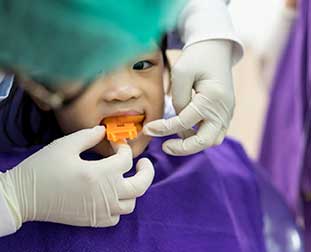
Modern pediatric dental X-rays are a good example of low-dose radiography. These X-rays use advanced digital sensors to produce higher resolution images with up to 80% less radiation exposure than conventional film-based X-rays.
Pediatric dentists use several types of X-rays during dental exams. These X-rays include:
Because only a third of a tooth is visible above the gumline, not all dental conditions can be diagnosed with just a visual examination. Dental radiography is used to diagnose issues, such as decay, infection, and injury, that can affect the health of a tooth.
Pediatric dental X-rays can help your child’s dentist detect:
Additionally, X-rays can help identify potential dental health problems early, before they become painful or costly to treat. Early diagnosis of common pediatric dental issues, such as cavities, can lead to minimally invasive treatments that are less stressful and more effective for young children.
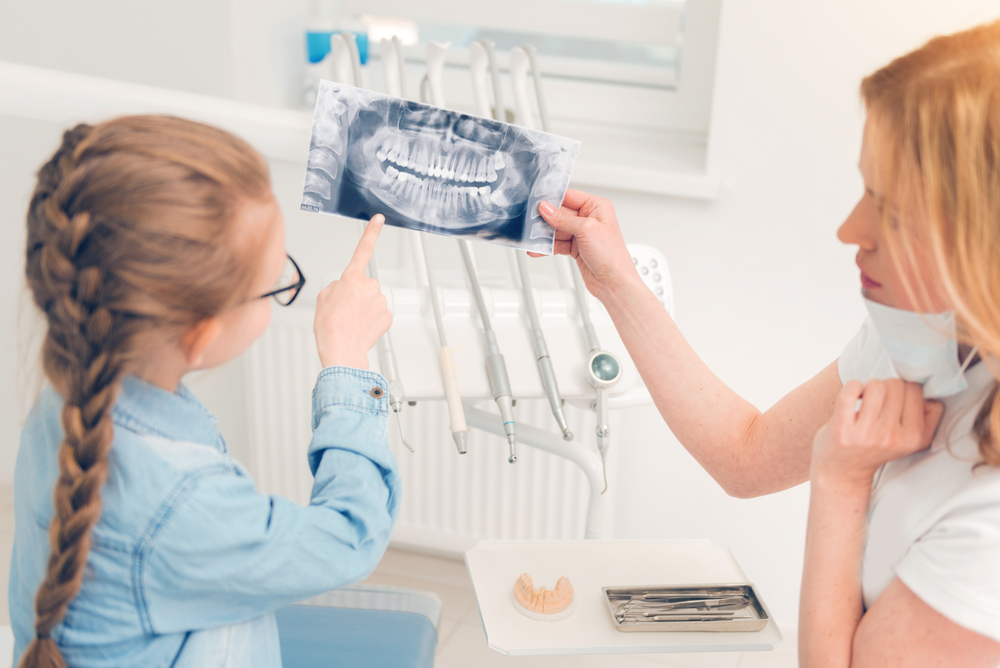
To create an image, an X-ray machine produces electromagnetic radiation, made up of photon particles, that passes through the body. It passes more easily through softer tissue, which appears gray on an X-ray, but is absorbed by harder tissues, such as bones and teeth, which appear white.
Low-dose radiography protects children by exposing them to less radiation than traditional X-rays. Using sensitive digital sensors, it requires up to 90% less radiation to create a clear image.
Modern pediatric dental offices follow the “ALARA” principle, which stands for “As Low As Reasonably Achievable.” This means that an X-ray is taken only when necessary, at the lowest possible radiation setting.
Low-dose radiography has eliminated the need for protective coverings, such as lead aprons and thyroid collars. In 2024, the American Dental Association (ADA) updated its X-ray safety guidelines, noting that protective coverings offer little to no added benefit for most people and can sometimes interfere with image quality.
There is no one set schedule for dental X-rays for children. Pediatric dentists usually base their X-ray recommendations on a child’s age, oral health history, and their individual risk level.
In general, a child with healthy teeth who follows a consistent home oral care routine would be considered “low-risk.” They might only require X-rays every 12-24 months, unless a dental problem arises.
Children with a history of cavities or other dental issues might benefit from X-rays every 6-12 months. More frequent X-rays can help ensure that plaque build-up, cavities, or infections are caught and treated early.
Your child’s pediatric dentist might also recommend X-rays when your child reaches certain developmental milestones, such as the arrival of permanent teeth, or if orthodontic concerns develop.
Many parents are surprised to learn that dental X-rays expose children to less radiation than they naturally absorb every day. Even the radiation levels of a traditional X-ray are less than a child’s “natural background” exposure.
Natural background radiation comes from many sources in a child’s life. It can come from organic sources, such as air and sunlight, or from electromagnetic fields produced by smartphones, tablets, and computers.

As a parent or caregiver, you should not hesitate to ask your child’s pediatric dentist any questions you may have, including questions about the use of dental radiography. Pediatric dentists are specially trained to address the unique concerns parents and caregivers may have about their child’s care, including the use of X-rays.
Some of the questions you may want to ask include:
Understanding the reasons for a child’s dental x-ray and the measures their pediatric dentist takes to minimize their radiation exposure can help you feel confident in your child’s care.
Advancements in digital imaging have made dental X-rays safer for children than ever before. By reducing the radiation required to produce images, dental radiography has become one of the safest diagnostic tools in healthcare today.
Is it time for your child to have a dental exam? Schedule an appointment at Premier Pediatric Dentistry in Miami, FL, today!